
Dryer Repair Services

24 -Hours Emergency Services

Satisfaction
Guaranteed

Same day service

Fast and reliable
Trusted Appliance Repair Across the Lower Mainland
See why local homeowners choose ElectraFix for fast, reliable appliance repairs.


Dryer Repair Services

ElectraFix repairs gas and electric dryers across the Lower Mainland, covering vented, ventless, and condensing models from all major brands. We carry OEM parts from the original manufacturer for the most common failures on the service vehicle and complete the majority of dryer calls on the first visit. All repairs include a written quote before any work starts, and the diagnostic fee is credited against the repair if you proceed. Call (778) 941-7758 for same-day or next-day availability.
Common Dryer Problems We Fix
Dryer Not Heating
No heat is the most common dryer fault we repair. The diagnosis differs between gas and electric models.
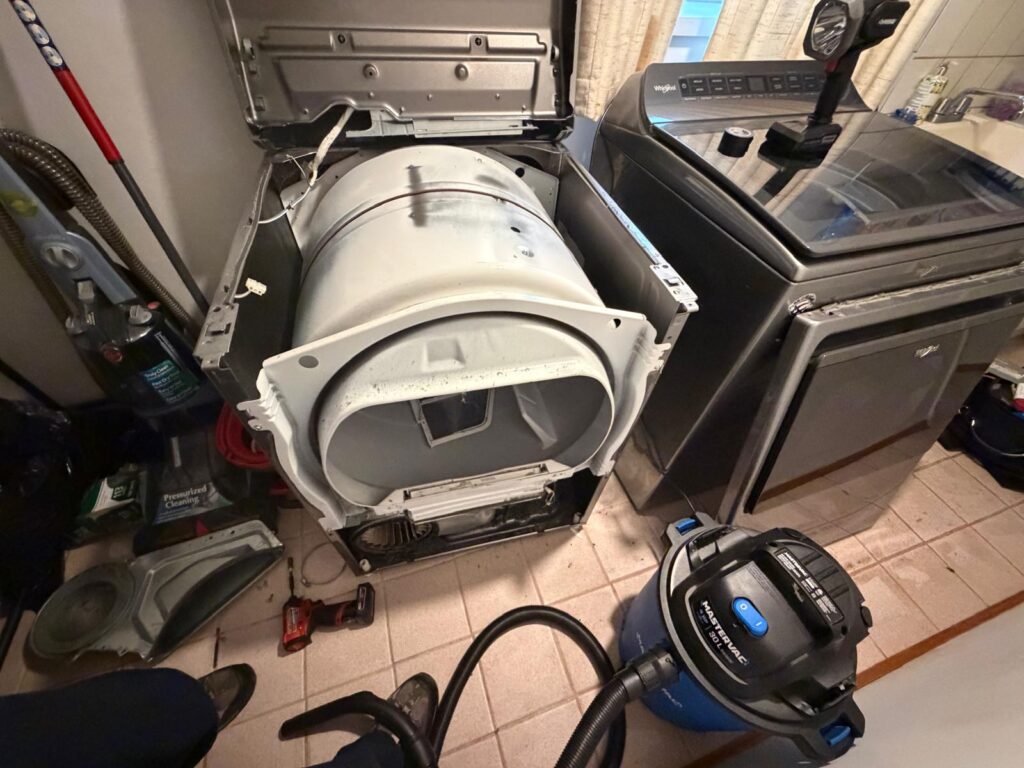
On an electric dryer, the heating element is the first component to inspect. Electric heating elements burn out over time and fail with a visible break in the coil. Heating element replacement runs $350 to $650 in parts and labour. If the element is intact, the thermal fuse and cycling thermostat are the next points of diagnosis. The thermal fuse is a single-use safety device that blows when the dryer overheats. Once it blows, the dryer produces no heat until the fuse is replaced. Unlike a circuit breaker, it cannot be reset. When we replace a thermal fuse we always identify the underlying cause, because a fuse that blows from restricted airflow will blow again if the vent is not cleared.
On a gas dryer, the igniter and gas valve solenoid coils are the most common failure points. The igniter heats to a glowing orange before the gas valve opens. A cracked or burned-out igniter glows briefly or not at all, and gas never flows. Solenoid coils on the gas valve hold the valve open during the heating cycle. One failed coil prevents gas flow even if the igniter is working correctly. The flame sensor monitors the igniter temperature before allowing the solenoid to open. All three components are testable with a multimeter and replaceable individually.
Dryer Takes Multiple Cycles to Dry
A dryer that runs full cycles but leaves clothes damp is moving air insufficiently through the drum. The cause is almost always airflow restriction.
Check the lint trap and the vent hose first. A partially blocked vent duct forces the dryer to run longer, raises internal temperatures, and shortens the life of the thermal fuse, heating element, and drum components. The blower wheel draws air through the drum and exhausts it through the vent. If the wheel is clogged with lint or has a broken blade, airflow drops significantly even with a clear vent duct. The moisture sensor, if fitted, reads the moisture level in the drum and extends the cycle when wet clothes are detected. A coated or failed moisture sensor extends every cycle indefinitely. We clean or replace the moisture sensor as part of the diagnosis when extended drying time is the complaint.
Dryer Won't Start
A completely unresponsive dryer with no display activity points to a power supply fault, a blown thermal fuse, or a failed main control board. Check the circuit breaker first. If the dryer has power and a display but does not start, the door switch is the most common cause. The door switch sends a signal to the control board confirming the door is closed. A failed switch means the dryer reads the door as open regardless of its actual position and will not start or spin.
A failed start switch, a broken drive belt, and a motor relay fault on the control board are secondary causes. On older timer-controlled dryers, a failed timer motor prevents the cycle from advancing. We test the door switch and drive belt before moving to the control board, because the board is typically the last component to fail and the most expensive to replace.
Dryer Won't Spin
A dryer that heats but does not tumble has almost always broken a drive belt. The drive belt wraps around the drum, the idler pulley, and the motor shaft. It is a wear component and breaks after years of use. When it breaks, the motor runs and the drum sits still. Replacing a drive belt is one of the most straightforward dryer repairs and one we carry stock for on virtually every brand.
Drum rollers support the rear of the drum and allow it to turn smoothly. When rollers wear out, they develop flat spots that cause the drum to wobble or seize. In some cases the drum will spin sluggishly but not complete the rotation cycle. The idler pulley maintains tension on the drive belt. A seized idler pulley prevents the belt from moving even when intact. We inspect the belt, rollers, and idler pulley together on every no-spin call since they interact and wear at similar rates.
Dryer Making Loud Noise
The noise type identifies the failing component.
A thumping or banging noise during tumbling is worn drum rollers. The rollers develop flat spots and produce a repeating thump with each rotation. On most dryers there are two or four rollers at the rear and sometimes two at the front. We replace all rollers on the same visit because if one has worn through, the others are at a similar point.
A high-pitched squealing noise is a worn drum bearing or a seized idler pulley. The drum bearing supports the front of the drum on some models. When its lubricant dries out, it produces a consistent squeal during tumbling. A seized idler pulley produces a similar sound.
A grinding noise that worsens under load points to worn drum glides or a fraying belt rubbing against a pulley. A rattling noise from inside the drum is almost always a loose object caught between the drum and the drum seals. Check the drum manually before calling.
Dryer Overheating or Producing a Burning Smell
A dryer that is hot to the touch on the exterior, produces a burning smell, or shuts off before the cycle ends is overheating. This requires immediate attention. Do not continue running the dryer.
The most common cause is restricted airflow. A blocked vent duct forces exhaust heat to recirculate inside the drum rather than exit through the wall. The cycling thermostat controls how hot the drum gets during normal operation. A failed cycling thermostat can allow temperatures to exceed safe limits without shutting the heating element off. Lint accumulation near the heating element can ignite at elevated temperatures.
A burning rubber smell specifically points to a fraying or slipping drive belt. A burning electrical smell points to a shorted heating element or failed wiring insulation. Both warrant stopping the dryer immediately and booking a service visit before the next use.
Dryer Shuts Off Mid-Cycle
A dryer that starts normally but stops before the cycle completes is tripping a safety component due to overheating. The thermal fuse opens when the dryer reaches a temperature above its rated limit. On some models the fuse is resettable; on most residential models it is not. A dryer that shuts off repeatedly mid-cycle has a restricted vent, a failed cycling thermostat, or a failing motor that overheats under load.
The moisture sensor can also cause early shutdowns on sensor-dry models if it reads the clothes as dry before they are. Cleaning the moisture sensor strips with a cotton swab and rubbing alcohol clears the coating that causes false readings. If the sensor is clean and the dryer still shuts off early, the control board or the cycling thermostat is the next point of diagnosis.
Dryer Types We Service
Electric Dryers
Electric dryers are the most common configuration in Lower Mainland homes and condos. They use a 240V heating element to generate heat and a drum motor and blower to circulate air. Parts availability is strong across all major brands and most repairs complete on the first visit. Heating element replacement, thermal fuse replacement, and drive belt replacement are the three most common electric dryer repairs we perform.
Gas Dryers
Gas dryers heat faster and typically cost less to run per cycle than electric models in BC, where natural gas rates are lower than electricity rates for high-draw appliances. Repairs involving gas supply components, gas valves, or igniters connected to the gas line require a licensed gas technician. ElectraFix holds the appropriate Technical Safety BC certifications for gas appliance repair in British Columbia. When booking a gas dryer repair, confirm the technician is licensed for gas work in BC before they open the appliance.
Ventless and Condensing Dryers
Ventless dryers do not exhaust air through a wall duct. Instead, a condensing dryer passes humid air over a heat exchanger that cools it and collects the condensed water in a reservoir or drains it directly. Heat pump dryers operate on the same principle but use a refrigerant cycle for significantly greater energy efficiency. Both types are common in Lower Mainland condos where external venting is not possible. Common faults include failed heat exchangers, blocked condenser coils, failed pump systems, and control board faults. We service all major ventless and heat pump dryer brands including Miele, Bosch, Blomberg, LG, Samsung, and Electrolux.
Stackable and Compact Dryers
Stackable dryers are standard in Vancouver and Burnaby condos. They are functionally identical to full-size models but with reduced drum capacity. Access in a laundry closet adds time to the repair but does not limit what can be fixed. Compact dryers in laundry closets often have shorter vent runs with more bends, which increases the rate of lint accumulation and the frequency at which the vent needs cleaning.
Dryer Repair Frequently Asked Questions
DRYER IS NOT HEATING
If the dryer is working but not producing any heat you are having the most common repair problem with dryers. Most of the time the issue is in a blown fuse or a faulty heating element. There are times when the main control board needs to be replaced in order to solve this problem.
- Thermal Fuse: The thermal fuse prevents the dryer from overheating. Fuses are possibly located on the blower housing at a dryer’s heat source. For electric dryers, this would be the heating element and for gas dryers, this would be at the burner. If the fuse has blown it will have no continuity as shown by a multimeter. Pro Tip: A blown fuse could be the sign of a clogged vent or exhaust pipe. Check as required.
- Gas Valve Solenoid:These are located on gas dryers. The gas valve solenoid opens allowing gas to flow to the burner. You must first check the igniter. If the igniter glows but does not spark the gas into a flame then the gas valve solenoid is malfunctioning and must be replaced.
- Igniter: The igniter is what sparks the gas into flame. You can use a multimeter to test the igniter for continuity.
- Heating Element Assembly: The heater element assembly heats the air inside your dryer and sends it into the drum. Over time it can burn out. It can be checked with a multimeter for continuity and repair or replaced as needed.
DRYER WON'T SPIN
When your dryer stopped spinning it is most likely caused by a broken belt. You can reach the drum and try turning it by hand – if it spins easily, the belt is probably broken or slipped off. A not spinning dryer appliance can be also due to a faulty drum roller. In rare cases the motor is faulty and the dryer won’t spin.
- Drive Belt:The drive belt is long and slender. It wraps around all the major components of a dryer: The drum, tension pulley, and drive motor pulley. You can easily check if the drive belt is broken by simply hand spinning the drum. If it spins too easily, the belt is most likely broken. You should always examine the belt for any signs of wear when you have a chance and replace it if needed.
- Drum Rollers:Depending on your dryer it might have two or more drum rollers. They are usually located at the rear and front of the drum and support it so that it can spin freely. The drum rollers can wear out over time making it difficult for the dryer to spin and placing excess stress on the motor. You can test your drum rollers by removing the drive belt and hand spinning the drum. If the drum does not spin evenly or freely you probably have to replace the drum rollers.
- Drum Roller Axels: The drum rollers are attached to an axel. The axels can become worn out too. You can test the drum roller axels the same way you would test the drum rollers. Both the axels and rollers must be inspected and usually, both would be replaced at the same time.
- Drum Slides: The drum slides are small pieces of plastic that guide and support the drum as it spins. They are located around the front of the drum. If the drum slides have worn out sometimes it creates too much friction and the motor won’t work. They need to be manually inspected and replaced as a set if they are worn out.
- Drum Bearing: The drum bearing is located at the back of the drum and is necessary for proper function. If you remove the drive belt and hand spin and feel/hear a grinding noise then the drum bearing may be at fault.
DRYER TAKES TOO LONG TO DRY
The dryer will take too long to dry if there is a problem with the airflow. If the vent is clogged the air circulation is restricted and the dryer would take a long time to dry – you should clean the vent at least once a year to prevent it from being clogged. Also, a faulty blower wheel would not draw enough air into the dryer causing it to dry longer, in many cases there is just a sock in the blower wheel and when removed solves the problem.
- Air Flow Issue: If the exhaust vent is clogged it will severely affect your dryer’s ability to get the job done. Too much moisture remains in the machine. Inspect your dryer’s vents manually.
- Lint Filter:The lint filter could be full or clogged. It can be manually cleaned.
- Blower Wheel:The blower wheel is attached to the drive motor and helps push air into the dryer drum. It can become blocked with lint and other dryer objects. You can determine if the blower wheel is defective by removing the vents and checking the power of the airflow. The blower wheel should not wobble when rotated by hand.
- Gas Valve Solenoid: The gas valve solenoids can turn to fail once the machine has started. This will cause longer drying times. You can test the solenoids by watching the igniter. If the igniter glows but does not ignite the gas your solenoid is defective.
- Heating Elements: The heating element heats the air. It can burn out. It needs to be tested with a multimeter and replaced if it has no continuity.
DRYER WON'T START
If your dryer won’t start it might be due to a blown thermal fuse that is there to protect the dryer from overheating. A common reason for this appliance repair problem is a faulty start switch, try starting the dryer – if it hums but won’t start the switch is ok, but if there is no humming sound and the dryer won’t start, it is most likely due to a faulty start switch. A door switch that prevents the dryer from starting if the door is open could also cause this problem.
- Thermal Fuse The thermal fuse protects the dryer from overheating. It is located on the blower housing or at the dryer’s heat source. The fuse can be checked with a multimeter for continuity. Pro Tip: A blown thermal fuse could indicate that you may have a restricted exhaust vent. Check it for blockages.
- Start Switch:If the start switch is defective the dryer won’t work. You can test the start switch by trying to start the dryer. If the dryer “hums” but does not start, your start switch is OK. If there is no noise the problem may be the start switch. Test with a multimeter.
- Door Switch:The door switch engages when you close your dryer’s door and you should hear it “click”. It can be tested with a multimeter.
- Drive Belt and Belt Switch: If the drive belt breaks the motor can still run on some models. The belt switch would shut everything down if the belt was broken. You must first determine if your model has a belt switch.
- Circuits Outlets and Plugs: Try plugging something else into the outlet. Check your circuit breaker for blown fuses. Inspect the dryer plug for signs of damage.
DRYER IS NOISY
If your dryer started to be noisy it is probably caused by a broken belt, a faulty drum roller, or a drum roller axle.
- Drive Belt:The drive belt is long and slender, wrapping all the way around the dryer drum, tension pulley, and drive motor. It is put under a lot of strain and can break or become frayed. If worn it needs to be replaced.
- Roller Drum:The drum rollers need to be inspected. Depending on the dryer model there may be only one drum roller or several. It probably makes sense to replace all the drum rollers if one is on the way out.
- Drum Roller Axle: Many dryers have two or more drum support rollers at the front and back of the drum. You can test the drum rollers by removing the drive belt and turning the drum by hand. If it spins evenly and freely the drum roller axels are OK.
Brands We Service
We repair all major dryer brands across the Lower Mainland including Samsung, LG, Whirlpool, Maytag, GE, Frigidaire, KitchenAid, Bosch, Miele, Electrolux, Blomberg, Fisher and Paykel, Kenmore, Amana, Asko, Speed Queen, Beko, Thermador, and more. OEM parts are carried on the service vehicle for the most common faults across standard brands. Miele, Bosch, and Blomberg parts are consistently available and we regularly service the stackable configurations from these brands found in Lower Mainland condo buildings.


Articles you may find interesting:
ElectraFix Appliance Repair
Book your dryer repair - call (778) 941-7758
- ✓ Same-day service availability
- ✓ Written quote before any work starts
- ✓ Diagnostic fee credited against the repair if you proceed