
Calibrating Fridge Thermostat for Accuracy
Why Thermostat Calibration Matters
Your refrigerator quietly protects hundreds of dollars worth of food each week, keeping your family safe from spoilage and helping you reduce waste. But what many homeowners don’t realize is that the heart of that performance lies in one small component: the thermostat. This simple device tells your fridge when to turn on, when to cool down, and when to shut off. If it’s out of sync even by a couple of degrees it can throw the whole system off balance. With diy access to refrigerator parts, maintaining or replacing the thermostat becomes more manageable for homeowners who want to take control of their appliance care.
An inaccurate thermostat can lead to food freezing when it shouldn’t, dairy spoiling prematurely, or your fridge working harder than necessary to maintain a consistent temperature. Over time, this not only wastes energy but also shortens the lifespan of your appliance.
In British Columbia, seasonal temperature swings and power inconsistencies are a quiet threat to your fridge’s stability. You might not notice it immediately, but those fluctuations can cause your fridge to drift out of calibration, especially if it’s an older unit or has been recently moved. Fortunately, thermostat calibration is a simple DIY task that doesn’t require special tools or technical expertise just a little patience and a thermometer.
This guide walks you through recognizing when calibration is needed, performing it safely, and maintaining your fridge’s optimal performance throughout the year.
Common Signs Your Thermostat Needs Calibration
If your fridge has been acting up lately, there’s a good chance the thermostat isn’t reading temperatures accurately. Calibration can fix many cooling inconsistencies before they turn into bigger (and more expensive) problems.
Here are several telltale signs that your thermostat might be off:
- Your food is freezing even in the fridge compartment. This often happens with leafy greens or eggs placed near air vents, but if it’s consistent across the fridge, it’s usually a thermostat issue.
- Dairy products or leftovers spoil sooner than expected. A temperature that’s even 2–3°C too high can significantly reduce the shelf life of perishable items.
- The fridge motor seems to run constantly or not enough. A miscalibrated thermostat can send incorrect signals to the compressor, resulting in overcooling or undercooling cycles.
- There’s frost or condensation buildup in unusual areas. This can indicate fluctuating temperatures inside the unit, a common side effect of incorrect thermostat readings.
- The temperature on the display doesn’t match what a thermometer shows. This is one of the clearest signs you’re due for a calibration check.
Any one of these signs may not seem urgent, but together, they indicate a thermostat that’s no longer in sync with the actual temperature inside your fridge. Left unchecked, this can result in spoiled groceries, wasted energy, and potentially even premature component failure.
Know Your Thermostat Type (Before You Calibrate)
Not all thermostats are created equal. Before you begin adjusting anything, take a moment to identify which kind of system your fridge uses. This will determine how you calibrate and whether you can at all.
- Digital thermostats are commonly found in newer fridges. These typically use push-button or touchscreen controls and display the current temperature on a small panel. They’re easier to adjust but don’t always provide precise calibration settings.
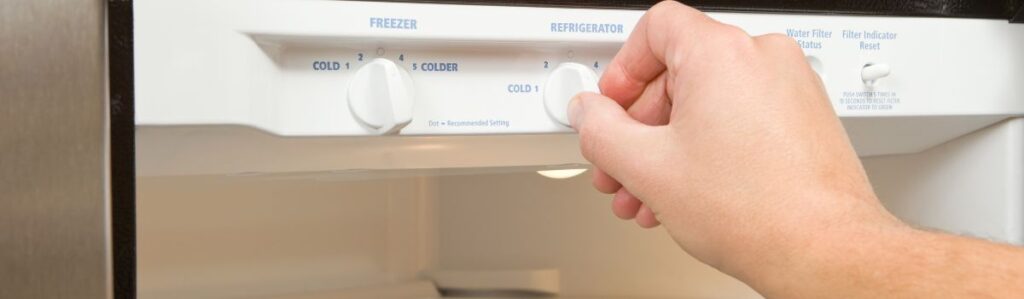
- Analog thermostats rely on a mechanical dial, often with numbered or notched settings. These are common in mid-range or older units and may be located behind a small plastic panel inside the fridge.
Some fridges, especially those with separate cooling zones, also use dual-sensor systems one for the refrigerator compartment and one for the freezer. In those cases, both need to be balanced to maintain an ideal environment.
You’ll typically find the thermostat mounted on an interior wall, near the light fixture, or in the control housing at the top. Some models hide it behind a cover you’ll need to remove before making changes.
It’s also important to note that thermostat calibration only solves problems caused by small internal drift over time. Suppose your fridge is experiencing major temperature swings, not cooling at all, or is completely unresponsive to setting changes. In that case, the problem may be more severe such as a failed thermistor, a damaged control board, or faulty wiring. In such cases, calibration won’t be effective, and you may require professional diagnostics.
Tools You’ll Need for Calibration
You won’t need a technician’s toolkit to get started. Most homeowners already have what they need or can easily find it at a hardware store. Here’s what to gather:
- Refrigerator-safe thermometer: This is your most essential tool. A digital model with a probe is ideal, but an analog liquid thermometer will also work as long as it’s designed for cold storage.
- Flathead screwdriver: Only necessary for analog thermostats, especially if they require opening a panel or adjusting a hidden screw.
- Multimeter (optional): Use this to test electrical continuity in the thermostat itself, especially if you suspect a mechanical failure.
- Timer or stopwatch: Timing is crucial for accurate fridge calibration. You’ll need to track how long it takes for the interior temperature to stabilize after each adjustment.
Optional bonus: For extra precision, use two thermometers one for the fridge and one for the freezer to ensure both sections are functioning properly.
Step-by-Step: How to Calibrate Your Fridge Thermostat
Prep the Fridge
Start by emptying the middle shelf of your fridge. This area offers the most consistent temperature reading, as it is away from vents, walls, and light bulbs that can skew the results.
Place your thermometer upright in a glass of water (for analog thermometers) or on a flat surface (for digital thermometers). Close the fridge and avoid opening it for at least 4 to 8 hours longer is better for accuracy. The goal is to measure the fridge’s actual steady-state temperature without any interference from door openings or recent use.
Compare Actual vs. Set Temperature
After the stabilization period, check the thermometer. Your fridge should be between 1.7°C and 3.3°C (35°F to 38°F). Freezers should maintain a temperature of around -18°C (0°F).
If your thermometer reads more than 1°C above or below the desired range, it’s time to calibrate. Also, note whether there’s a consistent difference between your set temperature and actual reading. This helps you fine-tune adjustments instead of making blind guesses.
Adjust the Thermostat
For digital models, use the “+” or “–” controls to raise or lower the set point by one degree. Allow the fridge another few hours to stabilize, then recheck the thermometer. Repeat as needed until the actual temperature matches your setting within a narrow range.
For analog thermostats, open the control panel (if needed) and locate the adjustment dial or screw. Mark the original position before turning anything. Rotate the dial slightly in the desired direction clockwise to make it colder, counterclockwise to make it warmer. Avoid large jumps. A quarter turn is usually enough.
Patience is key. Overcorrecting often leads to bouncing between too cold and too warm, so work in small steps and allow ample time for changes to take effect.
Retest and Repeat if Necessary
After each adjustment, wait another 4 to 8 hours before rechecking the temperature. Fridges don’t respond immediately, and rushing the process can lead to inaccurate conclusions. Expect to make two or three rounds of small adjustments before achieving a reliable and consistent result.
Keep notes if needed, especially if you’re testing both compartments or suspecting deeper inconsistencies. Consistency over time is what matters not a single reading.
Optional: Test Thermostat Accuracy with a Multimeter (Advanced Step)
If you’ve gone through the calibration process and your fridge still behaves unpredictably, your thermostat might be physically defective. A multimeter can help confirm this.
Start by unplugging the fridge. Then, remove the thermostat housing, which is usually located behind a control panel. Access the two terminals where wires connect to the thermostat. Set your multimeter to the Ohms (Ω) setting and check for continuity.
- If the thermostat has continuity at cold temperatures and opens at warm, it’s likely still working.
- If there’s no continuity or erratic readings, the thermostat may be worn out or stuck and needs to be replaced.
Only take this step if you’re confident handling electrical components. Otherwise, call a qualified technician for help.
When Calibration Won’t Fix the Problem
Sometimes, the thermostat isn’t the root cause it’s just one piece of a bigger puzzle. If you’ve followed the steps above and still experience inconsistent cooling, consider these other issues:
- Thermistor failure: The sensor that informs your control board of the temperature may be providing inaccurate readings.
- Control board malfunction: The electronic brain of your fridge might not be interpreting sensor data correctly.
- Damaged or leaking door seals: Even a small gap can let warm air in and trick your thermostat into overcompensating for the temperature.
- Clogged air vents or blocked fan: Poor airflow prevents temperature from spreading evenly inside the unit.
- Power fluctuations or electrical damage: These can disrupt the thermostat’s calibration and control functions.
When in doubt, it’s a smart move to get a professional inspection especially if your fridge is under warranty or still relatively new.
Preventive Maintenance to Avoid Future Issues
Once you’ve successfully calibrated your thermostat, you can stay ahead of future problems by building a few habits into your home maintenance routine:
- Clean your condenser coils every 6 months. Dust buildup forces your fridge to work harder, which affects its cooling performance.
- Avoid overcrowding shelves or blocking interior vents. Proper airflow is essential for consistent temperatures.
- Install a dedicated thermometer in your fridge to monitor temperature weekly.
- Check door gaskets regularly for cracks, tears, or loose seals.
- Recalibrate every 6–12 months, especially after a season change or power outage.
- Limit how often the door is opened especially in hot weather. Each opening allows warm air and humidity to enter.
If you’re in BC, it’s wise to check your fridge’s calibration in the spring and fall, when environmental temperatures and power loads tend to shift.
Frequently Asked Questions (FAQs)
How often should I calibrate my fridge thermostat?
Once or twice a year is typically enough. Check again if you move the fridge, lose power, or notice food not staying fresh.
Can I rely on my fridge’s built-in temperature display?
Built-in displays are often close but not always accurate. It’s best to cross-check with a dedicated fridge thermometer, especially during calibration.
What if my fridge is brand new but still not cooling properly?
It could need a factory reset or slight calibration due to transport or installation. If issues persist, it may be a warranty case.
Is it safe to calibrate my fridge myself?
Yes, as long as you follow the proper steps and avoid tampering with internal wiring unless you’re experienced.
Will calibration fix all cooling problems?
No, if internal components like the control board, thermistor, or seals are faulty, professional service is required.
Final Thoughts: Keep Your Cool the Smart Way
A well-calibrated fridge isn’t just about fresh groceries, it’s about confidence. Knowing that your appliance is cooling exactly as it should means fewer surprises, longer-lasting food, and lower energy bills. And in a place like British Columbia, where temperature and power can shift dramatically between seasons, regular thermostat checks are a smart, preventative habit.
Take the time to run through these steps. A properly tuned thermostat keeps your kitchen running smoothly and ensures your fridge remains a quiet, reliable partner in your daily life.